-
Despite ambitious phase-down commitments, many ASEAN countries remain heavily reliant on coal.
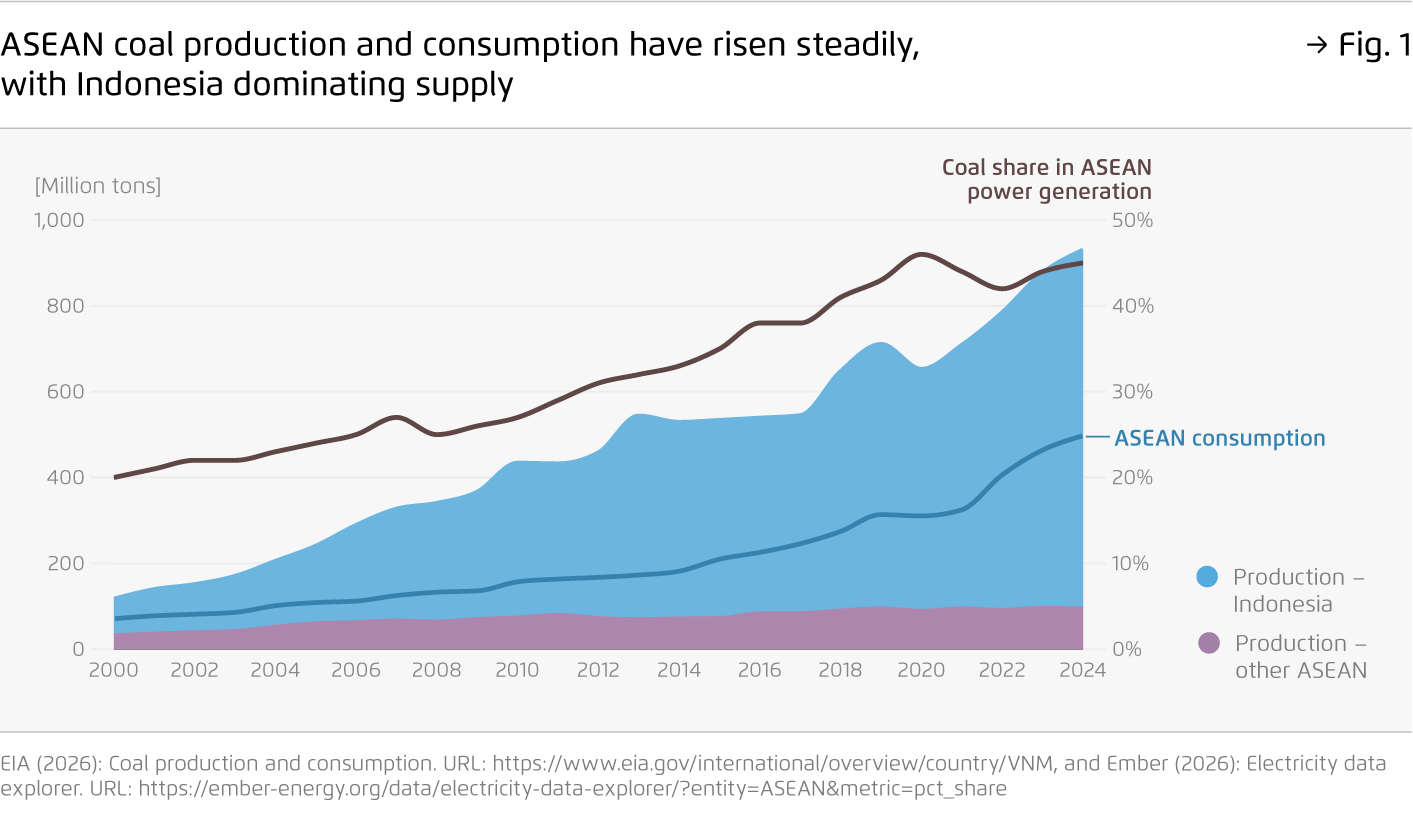
At 45 percent of ASEAN's electricity generation in 2025, coal dominates the power mix in Indonesia, Viet Nam and the Philippines. The 2026 energy crisis revealed a dual vulnerability: coal importers faced rising coal prices, while coal exporters faced pressure to restrict supply, reinforcing the case for scaling domestic renewables to boost energy security.
-
At the sub-national level, coal dependence creates significant barriers to a just transition, driven by local revenues dependence, informal employment and limited institutional capacity.
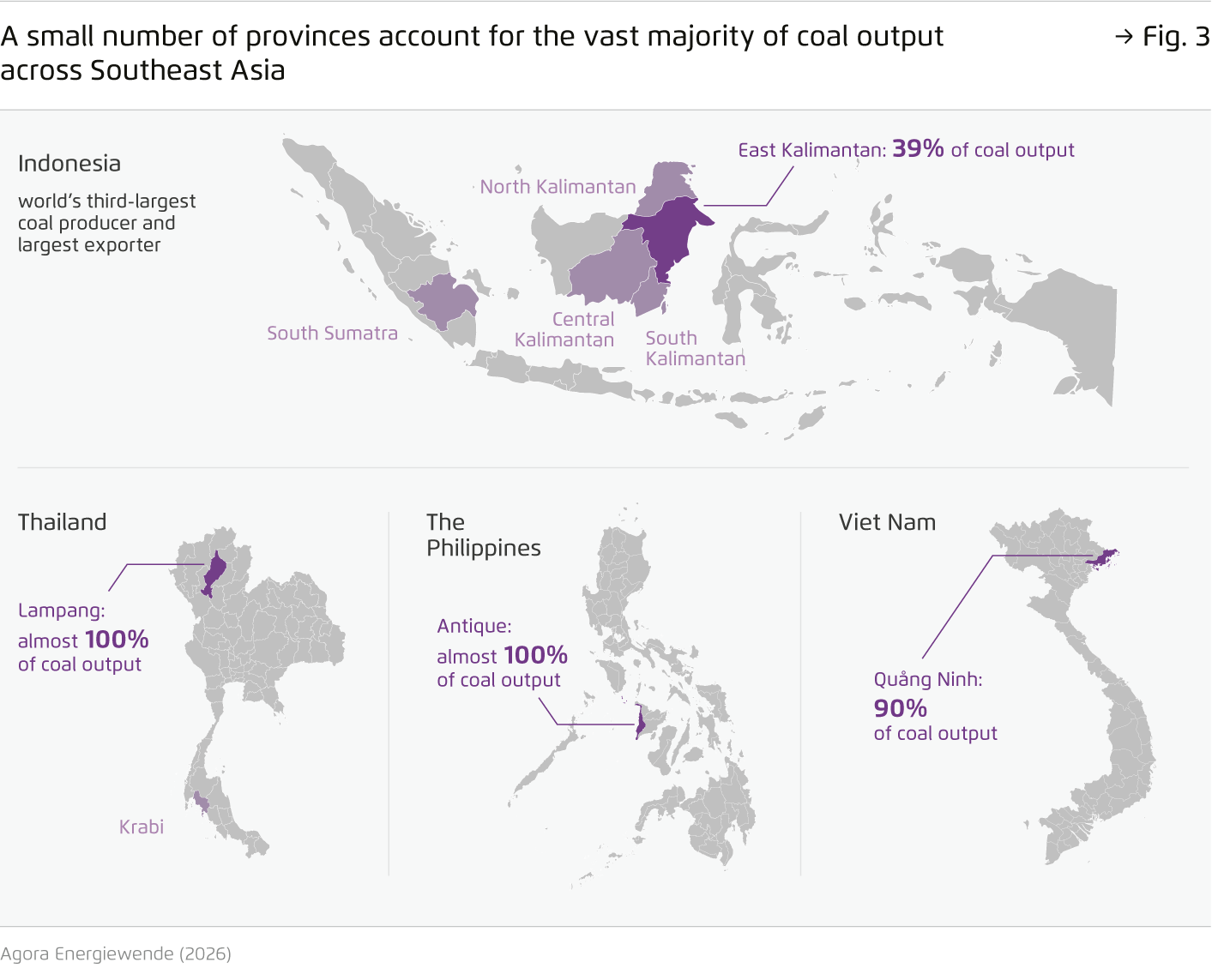
In provinces such as East Kalimantan (Indonesia), Quang Ninh (Viet Nam) and Antique (Philippines), coal accounts for up to 79 percent of local government revenue. The labour force is more vulnerable than official data suggests, with informal and migrant workers excluded from social protection and transition planning.
-
Addressing the vulnerabilities of coal-dependent provinces through economic diversification can create new sources of growth.
Yet it does not automatically deliver equitable outcomes: displaced workers face skills gaps, geographic barriers and temporal mismatches require coordinated policy responses across labour markets, social protection systems and local enterprise development. Countries that institutionalised transition commitments proved more resilient during the 2026 crisis.
-
Making coal plants flexible can facilitate near-term renewable integration if time-bound and part of transition plans.
The transition should be strategic: repurpose young plants for flexibility, keep mid-life for adequacy and retire the oldest. This approach requires revised power contracts, legally binding retirement schedules, faster renewables deployment and labour and social policies to support workers and communities.
Five enablers for a coal-to-clean energy transition in Southeast Asia
A bottom-up approach for a just transformation

Summary
Coal accounts for 45 percent of Southeast Asia's power mix in 2025, remaining dominant in Indonesia, Viet Nam and the Philippines. Despite phase-down commitments across ASEAN, implementation has not kept pace. The 2026 energy disruption exposed fossil fuel import dependency as a systemic vulnerability, while strengthening the strategic case for scaling domestic renewable energy across the region.
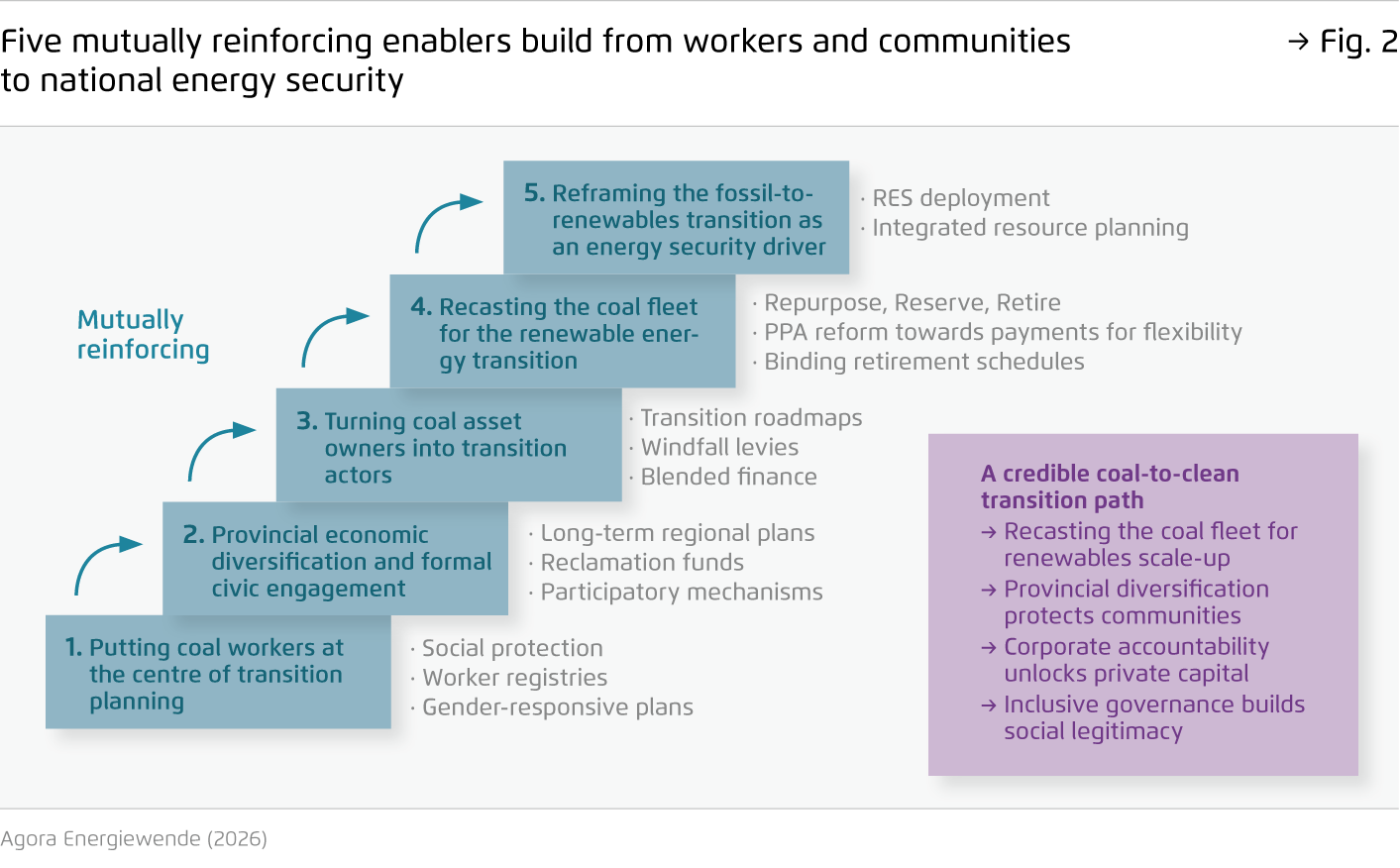
This Agora Energiewende policy brief takes a bottom-up approach to Southeast Asia's coal-to-clean energy transition, examining the conditions for a just transformation. It identifies five enablers: protecting coal workers and communities, diversifying coal-dependent provinces, redirecting corporate investment away from coal, recasting coal power plants through a Repurpose, Reserve, Retire framework, and scaling renewables as an energy security strategy. Evidence from Indonesia, Viet Nam, Thailand and the Philippines shows that transition succeeds when built on long-term planning, community participation and financing aligned with national policy.
With more than half of Southeast Asia's coal power plants still young, premature retirement neither economically nor politically viable. The brief proposes reforming power purchase agreements to increase the operational flexibility of coal-fired power plants and establishing binding retirement schedules alongside renewables scale-up, building the institutional architecture needed to turn coal transition commitments into lasting action across ASEAN.
Key findings
Bibliographical data
Downloads
-
Impulse
pdf 2 MB
Five enablers for a coal-to-clean energy transition in Southeast Asia
A bottom-up approach for a just transformation
All figures in this publication
ASEAN coal production and consumption have risen steadily, with Indonesia dominating supply
Figure 1 from Five enablers for a coal-to-clean energy transition in Southeast Asia on page 6

Five mutually reinforcing enablers build from workers and communities to national energy security
Figure 2 from Five enablers for a coal-to-clean energy transition in Southeast Asia on page 7