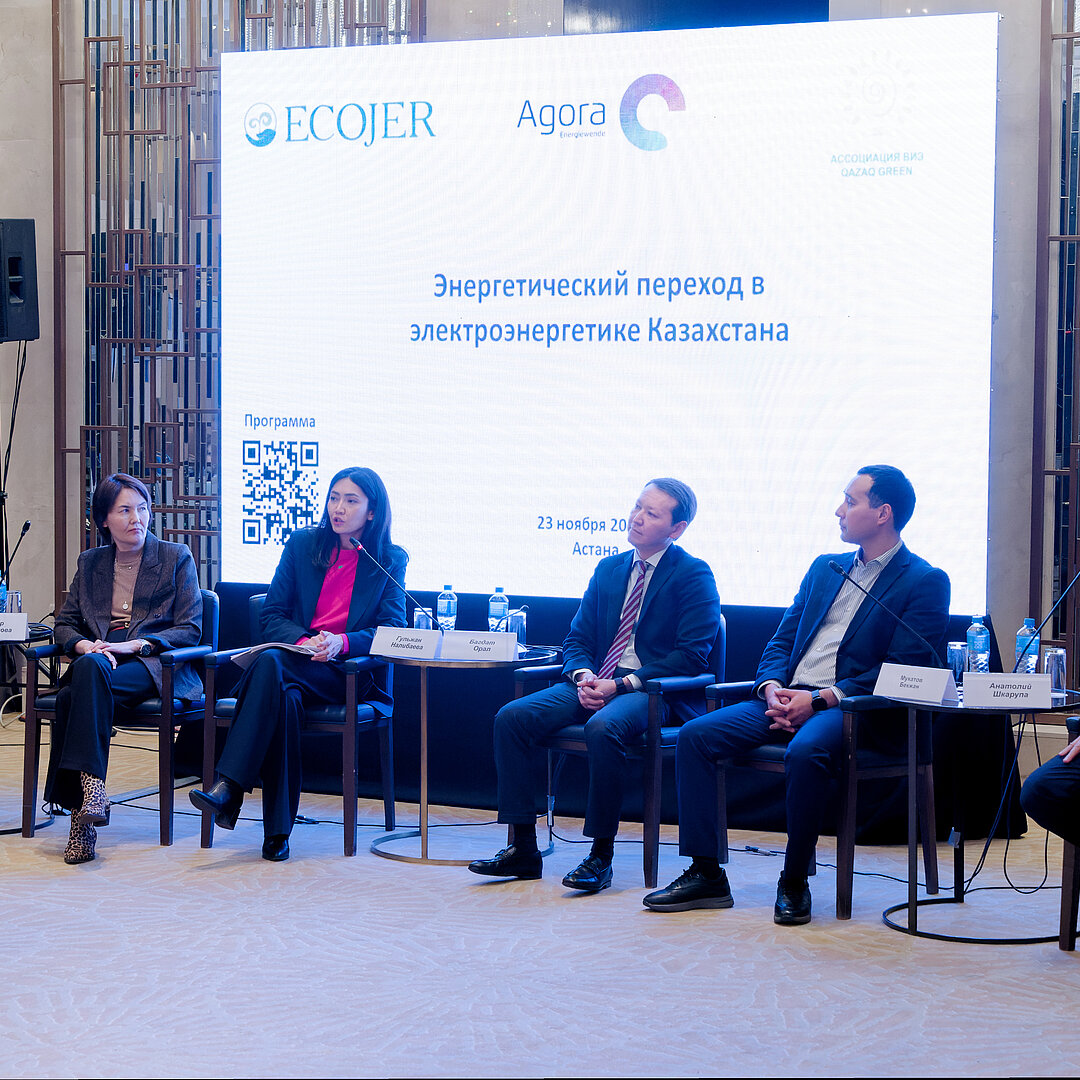
Unlocking a cheaper, more resilient Central Asian power system through regional integration and flexibility
Two new Agora policy briefs show that deeper regional power integration and greater flexibility could significantly reduce energy costs while enabling large-scale renewable energy deployment across Central Asia.
Central Asia could reduce annual energy costs by around USD 3.5 billion – or 18 percent – by 2035 through deeper cross-border power system integration, a new Agora policy brief based on modelling of high-renewable scenarios shows. A second policy brief on Kazakhstan’s readiness for renewable integration finds that renewable energy sources could supply over one third of the country’s electricity by 2035 if flexibility is embedded in planning and investment decisions.
The findings are timely as countries in the region plan major infrastructure and generation investments, including potential long-lived coal and gas assets. The coming years will determine whether the region locks into carbon-intensive capacity or builds a more flexible, lower-cost system based on renewables and cross-border cooperation. The briefs, developed in collaboration with the University of Central Asia, outline practical pathways towards a more flexible, secure and affordable power system for the region.
A more integrated regional system with untapped economic gains
The first policy brief centres on Central Asia, where power systems are highly complementary in their renewable resources: wind, solar and hydropower potential vary widely across countries, while national power systems remain distinct. Kazakhstan draws roughly half of its capacity mix from coal, Uzbekistan half from gas, and Kyrgyzstan primarily from hydropower. These differences, combined with complementary seasonal and geographic resource profiles, provide a strong foundation for a more integrated and efficient regional power system. Many of the physical interconnections between these systems already exist inherited from the former Soviet Union but are underutilised and in need of upgrading to enable modern power trade and regional balancing.
The modelling compares a reference scenario (current plans) with a high-renewables scenario (with no additional coal capacity). It shows that deeper cross-border coordination can significantly reduce costs through more efficient use of existing generation assets and improved balancing across borders. Stronger transmission links allow gas and coal plants to operate more flexibly across the region, reducing the need for expensive backup capacity.
Key high-value transmission investments include those between northern Kazakhstan and Uzbekistan, as well as between southern Kazakhstan and Kyrgyzstan. These interconnections become increasingly valuable as variable renewable generation increases and exposure to volatile international gas prices grows.
Beyond cost savings, deeper integration enhances energy security by reducing dependence on single-country balancing solutions and enabling higher integration of variable renewables without the risk of curtailment. Over time, improved coordination and market development could also position Central Asia as a potential electricity exporter to South Asia.
However, the analysis also highlights that current market conditions, including subsidised domestic gas prices in parts of the region, continue to favour gas-based generation in the short term. As domestic supply constraints tighten and import dependence increases, coordinated planning and investment frameworks become increasingly important for least-cost, resilient power system development.
Kazakhstan: flexibility as a key enabler of the transition
The second policy brief focuses on Kazakhstan, where the power system is entering a decisive investment phase. The analysis show that wind, solar and hydropower could increase to more than one third of total electricity generation by 2035, building on rapid recent growth from just 0.1 percent in 2015 to around 7 percent in 2025.
This trajectory is technically achievable, but it requires flexibility to be embedded as a core principle in system design, investment and operational planning. Achieving higher shares of variable renewable energy requires a power system that can adjust more dynamically over short and seasonal timescales.
The brief identifies a broad set of flexibility requirements across the system. These include improved operational performance of existing thermal power plants, enhanced demand-side response, better forecasting and digital system tools, as well as strengthened transmission infrastructure and interconnection with neighbouring countries. Energy storage also plays a key role in balancing short-term variability and supporting system stability.
Infrastructure development is therefore as important as generation expansion. Grid modernisation and regional interconnection enable electricity to flow more efficiently across space and time, reducing the need for redundant capacity and improving system resilience under high-renewable conditions.
Coal plant flexibilisation as a transitional measure
Upgrading existing coal-fired power plants in Kazakhstan can be a cost-effective transitional option to support renewable integration. Measures such as improved controls, operational adjustments and retrofits can reduce minimum load, improve ramp rates and shorten start-up times. In combined heat and power plants, thermal storage can further decouple heat and electricity production, improving operational flexibility.
At the same time, the analysis underscores the importance of a clear long-term transition strategy. Given that much of Kazakhstan’s coal fleet is over 50 years old, ensuring these interim measures align with a comprehensive coal phase-out plan is essential to a sustainable energy transition.
Policy priorities for aligning investment decisions with system needs
Across both the regional and national dimensions, flexibility and integration are emerging as key enablers of Central Asia’s energy transition. Regionally, stronger coordination can avoid duplicated investments, improve resilience to international fuel price volatility and enable more efficient use of renewable resources. This would also support a more stable long-term investment environment during a period of major infrastructure build-out. In Kazakhstan, improving power market design and system operation frameworks can unlock existing flexibility while encouraging investment in storage, demand response and advanced grid technologies. Building on existing mechanisms, including capacity markets and frequency control systems, improved remuneration of flexibility services would help align investment incentives with system needs.
As governments weigh new power system investments, the evidence shows how prioritising flexibility and regional integration can lower costs, improve security and accelerate the energy transition.
The two policy briefs, Cross-border power system integration in Central Asia and Kazakhstan’s readiness for renewable energy integration at scale are based on in-house modelling using Agora’s PyPSA-SPICE (PyPSA-based Scenario Planning and Integrated Capacity Expansion) Central Asia energy system model, a high-resolution power system optimisation framework developed to assess least-cost investment and dispatch pathways across interconnected electricity systems in the region. The model captures generation, transmission, storage and demand-side flexibility options, enabling detailed assessment of system-wide costs and operational dynamics under different policy and infrastructure scenarios. Both briefs are available for free download in English below. Russian translations will soon also be available.