-
Solar and wind power offer a major opportunity to reduce fossil fuel import dependence and lower consumer costs, yet many countries still lack the policy frameworks needed to scale them rapidly.
Persistent systemic and institutional barriers – such as fragmented governance, slow permitting and weak grid planning – slow development, despite mature technologies, strong investor appetite and available capital. Integrated policy design is essential to unlock large-scale deployment while safeguarding affordability, energy security, resilience and decarbonisation.
-
The “Renewable Energy Policy Framework” is a systematic tool to identify regulatory gaps and manage the policy trade-offs that shape solar and wind deployment.
Organised across seven policy areas and twenty four qualitative indicators, it helps stakeholders – from government representatives to civil society – diagnose bottlenecks and track reform impacts over time. Applied to eight Asian countries, the framework is designed to be scalable, supporting more coherent and evidence-based policymaking tailored to diverse national contexts.
-
Investment-friendly policy reforms – such as transparent procurement, streamlined permitting, better spatial planning and faster grid connection – are essential to improve project bankability.
Scaling up these measures strengthens investor confidence, mobilises capital at pace and builds a robust pipeline of bankable solar and wind projects aligned with national and international energy and climate objectives.
-
Baseload, top-down, centralised power generation is quickly becoming obsolete, as modern power systems prioritise flexibility and distributed resources in grid planning, development and operation to enable reliable and cost-effective renewables integration.
Well-designed regulations – such as flexible contracts with fossil fuel generators, short-term price signals with clear balancing responsibilities and cost-reflective grid charges – can unlock flexible responses from generators, storage operators and consumers, driving system-friendly infrastructure investments and strengthening overall resilience.
Renewable Energy Policy Framework: Power
A diagnostic tool to assess policy and regulatory barriers for solar and wind power deployment

Summary
The sharp reduction in prices of wind and solar energy over the past fifteen years have not automatically translated into deployment at the pace or scale required to meet climate targets in many countries. While technological costs and availability of finance were previously considered the main binding constraints for deployment, regulatory, institutional, grid-related and system integration barriers are emerging as key challenges today. Accelerating solar and wind deployment now requires policies that address a much wider set of systemic conditions, ranging from complex permitting procedures and outdated grid operations to absences of flexibility mechanisms or misaligned procurement frameworks. However, in many cases, national solar and wind energy policies haven’t kept up with these evolving conditions.
This report, developed by Agora Energiewende in collaboration with the International Network of Energy Transition Think Tanks (INETTT), applies a new Renewable Energy Policy Framework: Power (REPF) to eight Asian countries. It identifies and key policy and regulatory barriers to wind and solar deployment and explores concrete, implementable reforms to address them across diverse national contexts, power systems and electricity market structures.
The findings are complemented by a practical web-based platform and tool – featuring the REPF – designed to help governments and energy stakeholders move from high-level commitments on renewable energy deployment to implementation.
Find the Renewable Energy Policy Framework (REPF) platform and tool on the INETTT website:
Key findings
Bibliographical data
Downloads
-
Analysis
pdf 2 MB
Renewable Energy Policy Framework: Power
A diagnostic tool to assess policy and regulatory barriers for solar and wind power deployment
All figures in this publication
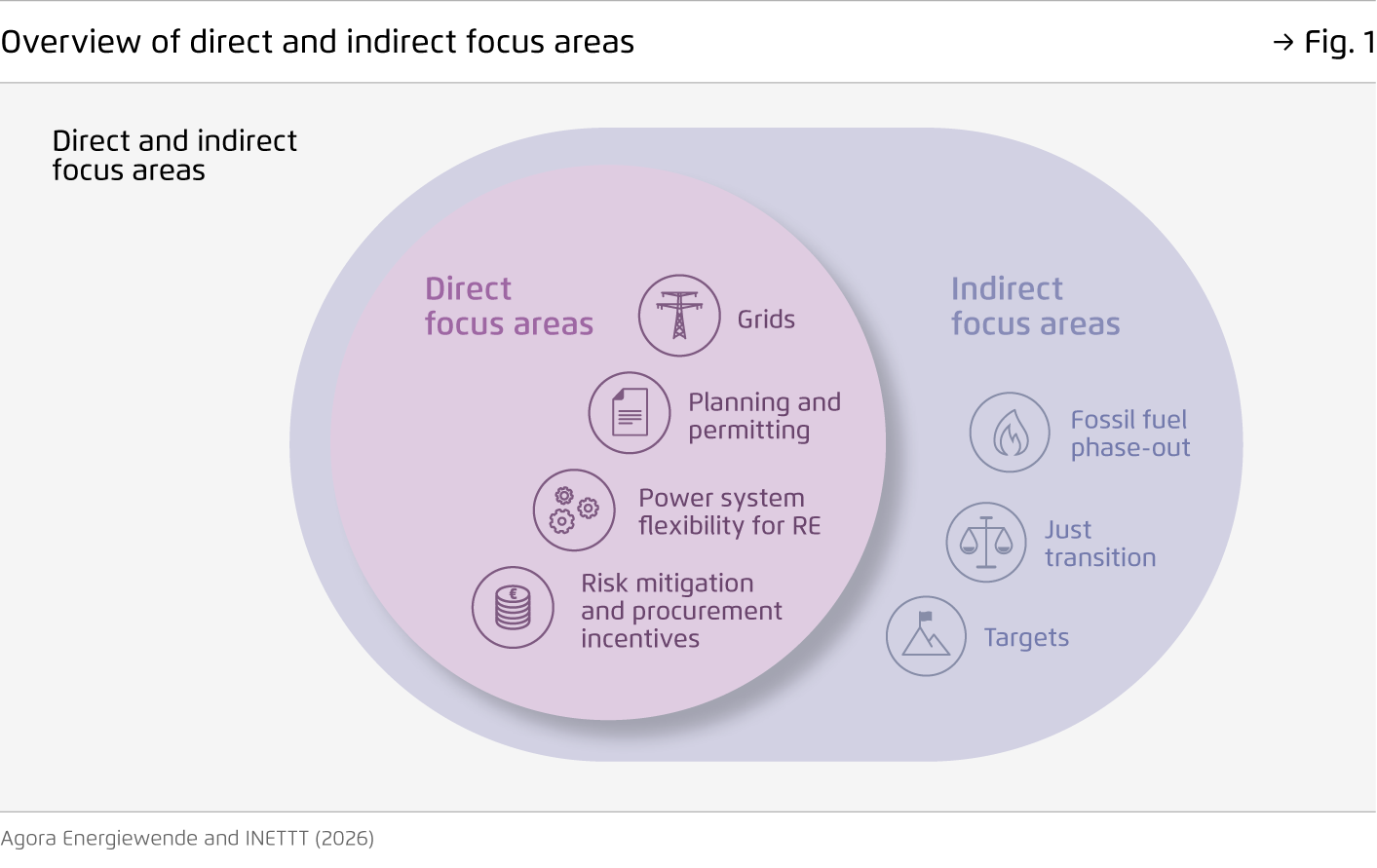
Overview of direct and indirect focus areas
Figure 1 from Renewable Energy Policy Framework: Power on page 7
Share:

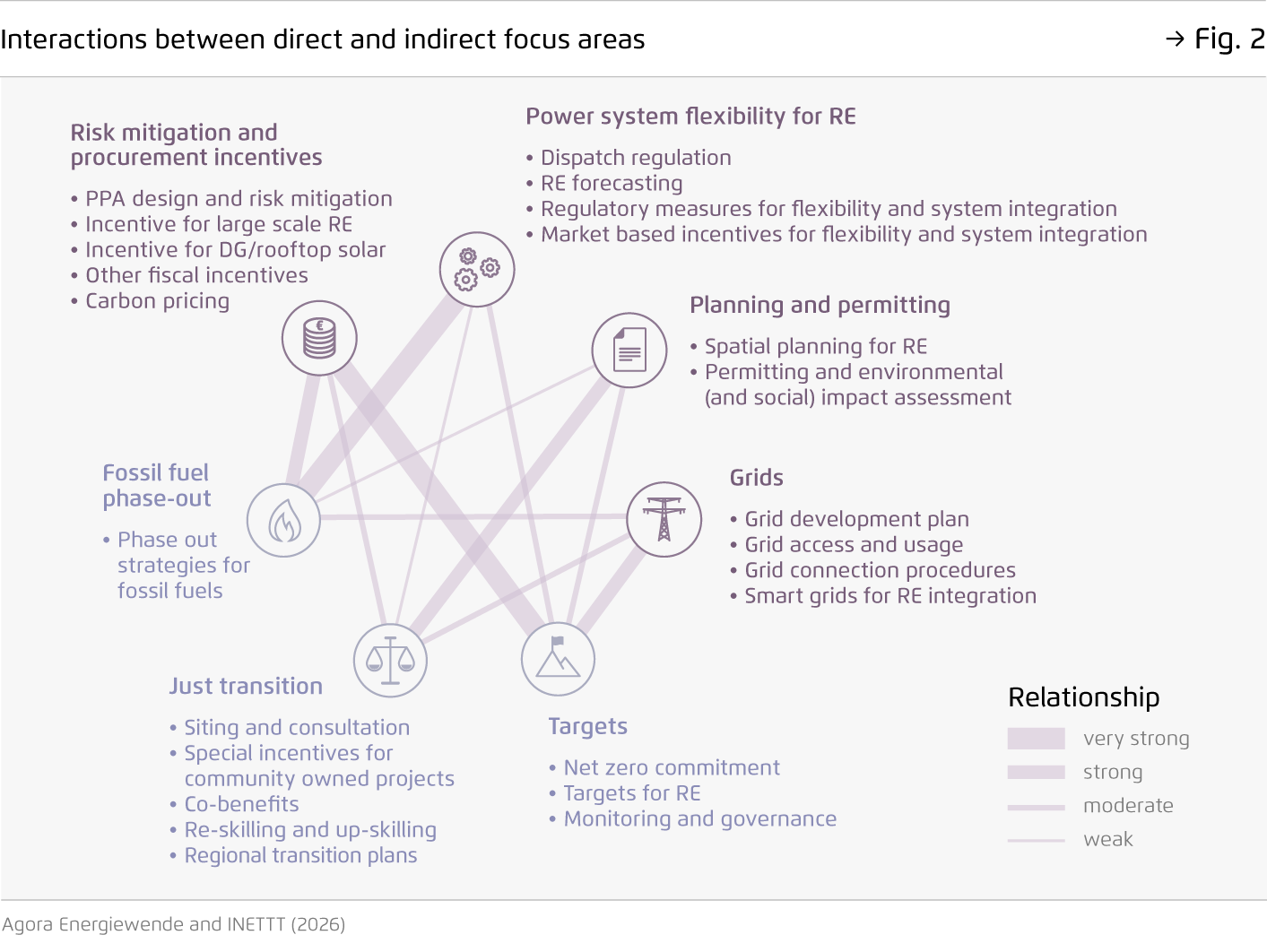
Interactions between direct and indirect focus areas
Figure 2 from Renewable Energy Policy Framework: Power on page 13
Share: