-
Short-term response
1. Clarifying the record after a blackout
The request: A blackout has just occurred, and news reports are blaming it on renewable energy making the grid unstable. We want to publish an article that sets the record straight, explaining what actually caused the blackout and how a modernised grid would help prevent this happening again. We would like support to make sure the technical details in our article are accurate.
Potential support: We would match the requesting organisation with a grid expert who could provide accurate technical information on what caused the blackout, and who would review the draft article line by line to confirm the details hold up. With this backing, the organisation could publish a credible, technically sound correction while the story is still live, keeping public discussion focused on the case for a more resilient grid.
2. Responding to a public consultation
The request: Our government has opened a two-week public consultation on a proposed change to grid policy. We have limited capacity and in-house expertise in this specific policy area to review the proposal thoroughly within the two-week window. We would like support to prepare a strong response before the deadline.
Potential support: A relevant expert would review the consultation document in detail and help the organisation write or refine its submission, such as a position paper or formal response, before the deadline closes. This would give the organisation the technical grounding to take part in the process with confidence.
-
Medium-term consultation
3. Building fact-based narratives for outreach
The request: In Southeast Asia, public discussion around grid modernisation has raised concerns that integrating more renewable energy will raise household electricity bills. We want to communicate on these topics with clear, accurate information, and we would like support developing the narrative.
Potential support: We would facilitate a session bringing relevant experts together with the organisation to review the evidence on these questions, then deliver narrative-building training to help shape clear, effective and evidence-based messaging on grid modernisation tailored for the region.
4. Learning from international experience on grid financing
The request: We want to build a better understanding of how the private sector can invest in grid infrastructure, including examples of what has worked well – and what has not – in other countries, and how these approaches might apply to our own situation. This would help us engage in upcoming discussions with government and regulators about policy and regulatory changes, and we need support communicating our key messages effectively to these decision-makers.
Potential support: We would connect the organisation with an expert who would help prepare a short policy brief summarising relevant international practice and options for the local context. The expert would join meetings, in person or online, to support the organisation’s discussions with government and regulators. Backed by well-researched evidence and a technical voice in the room, the organisation could make its case with credibility.
-
Long-term technical assignment
5. Strengthening the case for an efficient power development plan
The request: Our country’s next power development plan will be discussed and approved over the next two to three years. We are concerned that the initial proposals on the table would increase electricity costs and make poor use of existing resources. We need support to identify the right assumptions, scenarios and parameters to calculate the investment required accurately, and to develop a more cost-effective, resource-efficient alternative that better considers flexibility, energy efficiency and distributed energy resources, such as rooftop solar or small-scale storage.
Potential support: Technical experts would review the initial proposals, help review and define the key scenarios and parameters needed for a robust cost and investment analysis*, and share case studies from other countries where similar approaches have reduced costs. Over the course of this multi-year process, the organisation would gain a credible, evidence-based alternative to put forward, strengthening its hand at every stage of the discussion.
*GridACT’s offer excludes modelling
6. Designing what comes after expiring grid concessions
The request: The agreements allowing private companies to operate our national grid are set to expire in three years. Under the current arrangements, these companies have had limited accountability and little incentive to improve service quality or lower electricity bills for customers. We want to explore what alternative models, both financing and governance, could work better going forward, and to engage with stakeholders before final decisions are made.
Potential support: We would bring in experts to review international examples of different concession and governance models, help assess which could realistically fit local conditions, support the design of a stakeholder engagement plan, and facilitate workshops or dialogues with key stakeholders to build shared understanding. This would position the organisation to help shape a stronger, more accountable model from the outset, rather than responding to terms already set by others.
GridACT
Grid Advisory and Civil Society Technical Support on grid modernisation

Why does grid modernisation matter?
Across South, Southeast and East Asia, governments are making foundational decisions today about how power grids are planned, built and operated – decisions that will determine whether grids become an enabler of the region’s clean energy transition, or a bottleneck that holds it back. By 2040, the world will need to add or refurbish the equivalent (International Energy Agency (IEA): 2026a) of its entire existing grid to meet climate and energy goals. ASEAN countries need more than US$320 billion (International Energy Agency (IEA): 2026b) in grid investment by 2040 to accommodate a 75-percent rise in electricity demand and a doubling of total electrical capacity, with renewables supplying much of the new capacity.
Introducing GridACT
Facilitated by Agora Energiewende, GridACT is a free, on-demand matchmaking platform connecting users with a curated network of grid modernisation experts, who can help with tailored technical support and knowledge transfer around these topics. GridACT is open to civil society organisations, think tanks and policy institutes of all sizes and levels of experi-ence that are based in South, East or Southeast Asia and work on grid and power sector issues in the region.
What can GridACT help with?
GridACT supports organisations across the full sweep of issues shaping power grid modernisation. In practice, this could mean reviewing a draft grid code, helping to identify assumptions for modelling or drafting a policy brief on private sector investment in grid infrastructure – shaped around what the organisation needs most.
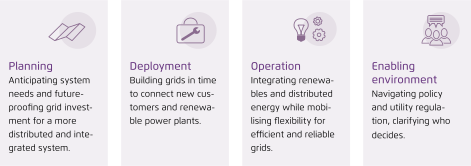
Four areas of grid modernisation
How does our support work?
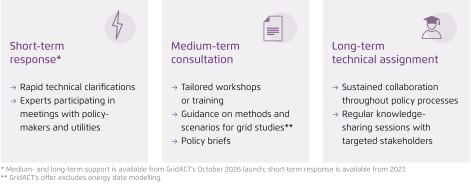
Examples of GridACT support in practice
How do I get started?
- Complete the request form: Tell us about your organisation and what you need.
- Intro meeting: Discuss your request in more detail with GridACT.
- Get matched: Connect with a relevant grid expert.
- Ongoing support: GridACT guides the collaboration towards real impact.
Q&A about GridACT
GridACT opens for its first intake of organisations from November 2026. Ready to boost your organisational voice in grid policy?
-
Who can apply?
Any civil society organisation, think tank or policy institute working on grid or power system topics in South, East or Southeast Asia can apply. We will review each request, giving priority to organisations whose geographic focus most closely aligns with GridACT's.
-
Is it free?
Yes, all support is free of charge.
-
Not sure what you need?
That's fine. Reach out by email to gridact(at)agora-energiewende(dot)de or complete the request form. We will help you define the scope together in an introductory call.
Request form
To request support from GridACT, please fill our request form. Your responses will be kept strictly confidential and shared only within the GridACT project team.
Bibliographical data
Downloads
-
Attachment
pdf 151 KB
GridACT ‒ Grid Advisory and Civil Society Technical Support on grid modernisation
Two-page overview of GridACT